Google Pixel 11 Pro Fold arrives · A rebuilt hinge, a light-up camera bar and the thinnest Pixel fold yet

Par Peak Phones editorial desk · Publié le · Mis à jour le
Highlights: what's new
- A hinge with no gears, the first rebuild of the mechanism since Google started making foldables.
- A glass-fibre composite back that Google says is close to impossible to crack.
- HiLight, an LED ring built around the camera flash that glows in colour for calls from chosen contacts or when Gemini is listening.
- Sign-to-text, developed with the Deaf community: American Sign Language printed on the outer display.
- Both screens reach 3,600 nits and both run 1–120 Hz.
- IP68 dust and water resistance, more than Samsung's or Motorola's foldables offer.
- Tensor G6 with 16 GB of RAM on every configuration, from 256 GB up to 1 TB.
- €1,999 / £1,799 / $1,899, pre-orders open now, on sale 20 August 2026.
A foldable that finally feels finished
Google's foldable has always been the interesting one to hold and the hard one to justify: thick, heavy, and carrying a camera a class below what the price implied. The Pixel 11 Pro Fold is the first generation that reads as a finished product rather than a first attempt.
What has not moved is the camera. The Pro Fold carries the same 48 MP main, 10.5 MP ultra-wide and 10.8 MP 5× telephoto as the standard Pixel 11, not the 50 MP and 48 MP periscope stack of the Pixel 11 Pro. At €1,999 that is the tension in this phone, and it runs through the rest of this article.
Pixel 10 Pro Fold vs Pixel 11 Pro Fold: what changed
One generation on, the changes are concentrated in the chassis and the screens rather than the camera. Against the Pixel 10 Pro Fold:
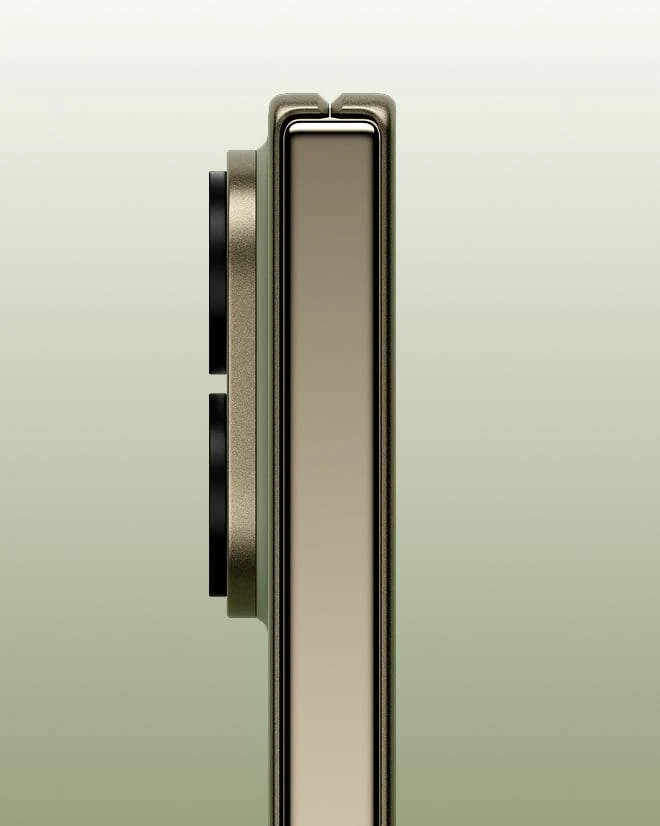
- Body: 10.1 mm folded and 5 mm open, against 10.8 mm and 5.2 mm, and 239 g against 258 g – 19 g lighter.
- Hinge and glass: the gears are gone and the new hinge has a larger bend radius; the outer cover glass moves from Gorilla Glass Victus 2 to glass ceramic. With the new back, Google sums the three up as three times the durability.
- Cover screen: 6.5 inches at 1–120 Hz, where the Pixel 10 Pro Fold's 6.4-inch panel bottomed out at 60 Hz. Dropping to 1 Hz on a static screen is the bigger practical change, not the extra tenth of an inch.
- Brightness: peak climbs from 3,000 nits, and the inner screen's HDR figure from 1,800 to 2,000 nits.
- Silicon: Tensor G5 and Titan M2 become Tensor G6 and Titan M3. Memory does not move – 16 GB was already standard across the range.
- Main camera: same 48 MP resolution and f/1.70 aperture, but the sensor grows from 1/2 inch to 1/1.56 inch, the first meaningful optical upgrade this line has had. The 10.5 MP ultra-wide and 10.8 MP telephoto are carried over untouched.
- Zoom: Super Zoom stretches from 20× to 30×, and Google adds 2× to the list of magnifications it calls optical quality.
- Battery: down, not up. 5,015 mAh becomes 4,806 mAh, the price of the thinner body. Wireless charging answers back, moving from 15 W Qi2 to 25 W Qi2.2; wired stays at 30 W.
- Price: €1,899 became €1,999, and £1,749 became £1,799.
The honest summary is that this is a build-quality generation. If you own a Pixel 10 Pro Fold, the reasons to move are the weight, the hinge and the outer screen's refresh range – not the photography, and certainly not the battery.
Design and build: 5 mm open, and a camera bar that glows
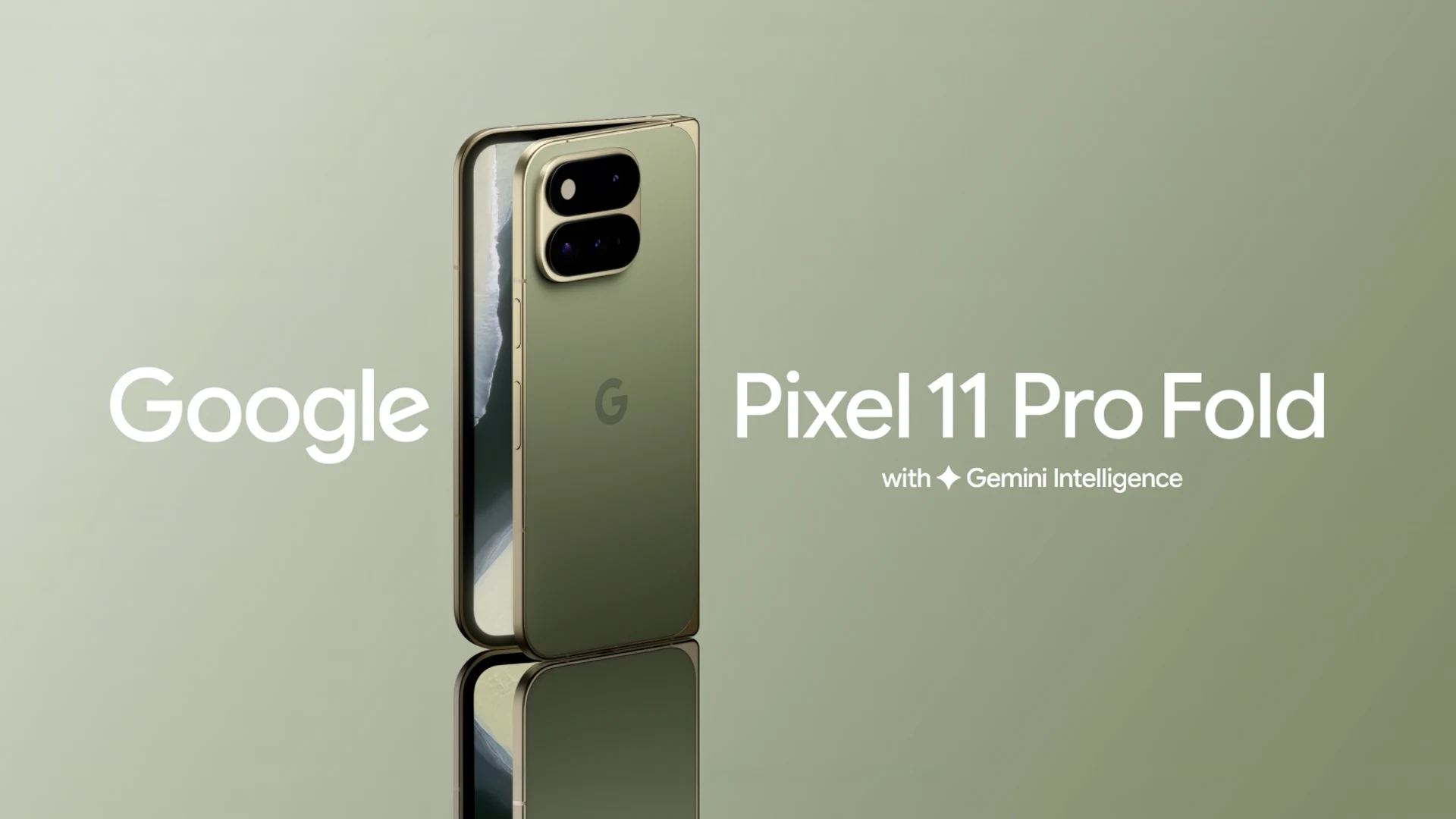
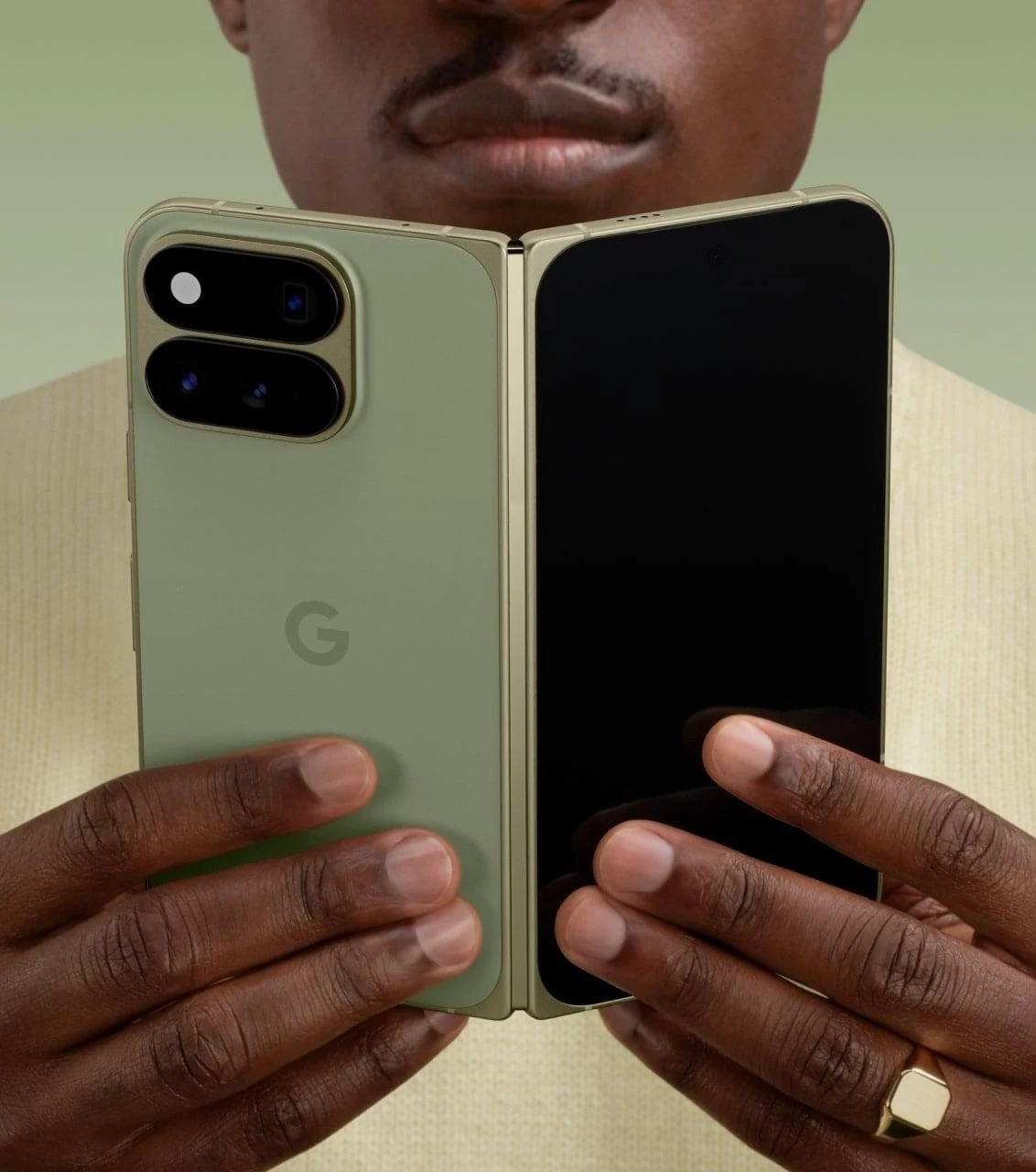
Folded, the Pro Fold is 155.2 × 76 × 10.1 mm; opened, it is 155.2 × 150.4 × 5 mm, and it weighs 239 g. The bezels around both panels are slimmer than before, which is how the cover screen gained a tenth of an inch without the phone growing. The frame is aluminium, the back has a matte, fingerprint-resistant finish, and there are two colours: the familiar Obsidian and a new Olive.
Protection is IP68, so dust as well as immersion in fresh water. Against the Samsung Galaxy Z Fold8 and Motorola's foldables, which stop at IP48 and cover no dust at all, that is a real lead. The Chinese foldables are already past it, though: the HONOR Magic V6 adds IP69 on top of IP68, and the vivo X Fold6 manages IPX8 and IPX9. Google also publishes no depth or duration for its rating.
The camera bar is the visible novelty. It is no longer just an island – Google has ringed the flash with LEDs it calls HiLight, which glow in colour when a favourite contact rings or when you are talking to Gemini hands-free, with message notifications promised later. It is a small idea, well executed: the information you want at a glance without opening the phone.
That bar also sits in the top corner of the back rather than across the middle, so the folded phone rocks on a desk when you tap the far side of the cover screen. At 239 g it is more noticeable than on a lighter phone, and it is the one ergonomic mark against an otherwise careful design.
Displays: 8 inches inside, 6.5 outside, both at 3,600 nits
The inner Super Actua Flex panel measures 8 inches at 2076 × 2152 and 372 ppi, under Ultra Thin Glass. The outer Super Actua display is 6.5 inches at 2342 × 1080 and 399 ppi in a 19.5:9 shape, so it works like a normal phone screen rather than the narrow strip earlier foldables shipped.
Both panels run 1–120 Hz and both reach 2,000 nits in HDR and 3,600 nits at peak – a 20 % gain on the previous generation, and the same peak figure as the Pixel 11 Pro. Contrast is quoted above 2,000,000:1 on the cover screen and 1,500,000:1 inside, with full 24-bit colour.
Google says the crease is shallower than last year, but it is plainly visible in Google's own imagery as a darker band down the middle of the inner panel. Two things follow from that: your finger drops into the groove every time you drag across the screen, and the line stays in the picture when you watch video or look at photos on the open display. The shallower it is, the better – and here the Pro Fold is a generation behind the OPPO Find N6 and the HONOR Magic V6, where it has effectively been engineered out.
Performance: Tensor G6, and 16 GB no matter which one you buy
The Tensor G6 pairs with the Titan M3 security coprocessor and a hardware stack that now includes quantum-safe secure boot. As on the rest of the line, Google frames the generational gain in on-device AI throughput rather than CPU position.
The welcome decision is memory: 16 GB of RAM on all three configurations, not just the expensive ones. Storage runs 256 GB, 512 GB or 1 TB, with the two larger tiers moving to Zoned UFS. A foldable lives on multitasking, so making 16 GB the floor rather than the ceiling matters more here than on a slab.
Connectivity is the full Pro set: Wi-Fi 7, Bluetooth 6, ultra-wideband, Thread, USB-C 3.2, dual-band GNSS and 5G on both Sub-6 and mmWave. The SIM setup is one nano-SIM plus eSIM.
Battery and charging: still under 5,000 mAh
The cell is 4,806 mAh typical, 4,658 mAh rated, and Google quotes over 24 hours of use. Wired charging is 30 W over USB-C PPS, good for about 50 % in half an hour, and wireless is 25 W over the Qi2.2-certified Pixelsnap system – Google's figure is 20 % faster than the previous Fold. The charger is not in the box; you get the phone, a one-metre USB-C cable and a SIM tool.
This is the specification sheet's weakest line, and the one place the phone went backwards. The room was there: at 9.4 mm and 228 g the vivo X Fold6 is both thinner and lighter than the Pro Fold, and it still fits 7,000 mAh – 2,194 mAh more – with 80 W charging. The HONOR Magic V6 manages 6,660 mAh at 8.75 mm. Google's answer is efficiency rather than capacity, and it is the claim that will decide whether this phone survives a long day on the inner screen.
Cameras: the one place the Pro Fold is not a Pro
The main camera is a 48 MP Quad PD sensor at f/1.70 on a 1/1.56-inch chip with an 85° field of view – new for this generation, and the best part of the set. Beside it sit a 10.5 MP ultra-wide at f/2.2 covering 127° with autofocus and Macro Focus, and a 10.8 MP telephoto at f/3.1 on a 1/3.2-inch sensor with 5× optical zoom and stabilisation. Super Zoom reaches 30×, with Google claiming optical quality at 0.5×, 1×, 2×, 5× and 10×.
Read those sensor sizes next to the price. The 10.8 MP 1/3.2-inch telephoto and the 10.5 MP 1/3.4-inch ultra-wide are the same small parts as the standard Pixel 11, while the Pixel 11 Pro gets a 48 MP periscope on a 1/1.95-inch sensor and a 48 MP autofocusing ultra-wide. Paying €800 more for the foldable means accepting a materially weaker camera than the bar phone in the same line-up.
There are two 10 MP f/2.2 selfie cameras, one on each screen, and the rear cameras can shoot your portrait using the cover display as a viewfinder – the trick foldables do best. Video tops out at 4K 60 fps front and rear, with 1080p slow motion to 240 fps and 10-bit HDR, but no 8K mode. New this generation are Magic Capture, which picks the moment out of a burst, and Camera Looks for consistent styling.
Software: seven years of updates, and a useful accessibility first
The Pro Fold launches on Android 17 with seven years of OS, security and Pixel Drop updates, the longest pledge in Android.
The foldable-specific work is better than usual. Any app can be turned into a bubble that parks in the corner of the open screen, on top of the existing split screen, drag and drop and Instant View. The standout, though, is sign-to-text: developed with the Deaf community, it reads American Sign Language through the front camera and prints the translation on the outer display, so the person you are signing to reads it directly. It works one-handed or two-handed, and the two-screen shape is what makes it practical.
The rest is the Pixel 11 software set: Gemini Intelligence with proactive suggestions, Gemini Live, Circle to Search wired into the camera, Live Translate, Call Assist. Security includes VPN by Google at no extra cost, scam protection in Phone and Messages, and Satellite SOS.
Price and availability
The Pixel 11 Pro Fold starts at €1,999 in Europe, £1,799 in the UK and $1,899 in the US, for 16 GB with 256 GB. The 512 GB and 1 TB versions sit above that – $2,019 and $2,249 respectively on the US store.
Pre-orders opened with the announcement on 12 August, and the phone goes on sale 20 August 2026, the same day as the Pixel 11 Pro and Pro XL. European retailers already list it for that date at Google's own price. Google sells the Pixel directly in the US as well as in Europe, so unlike most foldables at this level there is no import question.
Launch promotions are heavy: trade-in credit up to $1,000 in the US, a Pixel Watch 5 or $350 in store credit with a pre-order, and a £100 gift card at some UK retailers, all running to 27 August.
Caractéristiques clés
- Écran principal
- 8″ Super Actua Flex OLED
- SoC
- Google Tensor G6
- Batterie
- 4806 mAh
- Poids
- 239 g
- Capteur principal
- 48 MP grand-angle
- Certification IP
- IP68
Ce qu'on aime
- Thinner and lighter than its predecessor: 5 mm open, 10.1 mm closed, 239 g
- IP68 dust and water resistance, where Samsung's and Motorola's foldables stop at IP48
- Both screens hit 3,600 nits at 1–120 Hz, and the cover panel is a normal 19.5:9 shape
- 16 GB of RAM on every configuration, including the 256 GB base
- Sign-to-text turns the two screens into a real accessibility tool, not a demo
- Seven years of OS, security and Pixel Drop updates
Ce qui pourrait être mieux
- Camera hardware is the standard Pixel 11's, not the Pro's: 10.8 MP telephoto and 10.5 MP ultra-wide at €1,999
- The inner display's crease is obvious even in Google's own imagery, where the Find N6 and Magic V6 have all but removed it
- Camera bar sits in the corner, so the folded phone rocks on a desk when you tap the far side of the screen
- The heaviest (239 g) and thickest (10.1 mm) foldable in its class, and it still has the smallest battery: 4,806 mAh and 30 W against the vivo X Fold6's 7,000 mAh and 80 W
- No 8K video, unlike the Pixel 11 Pro
- No charger in the box
Verdict
The Pixel 11 Pro Fold is worth a look, but it does not hold up against the Chinese foldables. It is the heaviest and thickest fold we cover – 239 g and 10.1 mm closed – and it still has the smallest battery and the slowest charging in the class. Those grams and millimetres are buying nothing. Add a camera lifted from the standard Pixel 11 and a crease you notice at a glance, and next to the Chinese folds this reads as last year's phone. For the same €1,999 the Samsung Galaxy Z Fold8 is 38 g lighter. What Google did well is the build and the software – the new hinge, IP68, 16 GB at every tier, seven years of updates and a sign-to-text feature nobody else has. That makes it the best foldable Google has made. It does not make it the best foldable you can buy.
Google Pixel 11 Pro Fold
UE
fnac.com
Si vous achetez via les liens de notre site, nous pouvons toucher une commission. Cela n'influence jamais nos articles.
Sources
Plus d'actualités

23 juillet 2026
Samsung Galaxy Z Fold8 Ultra · Le premier pliable Ultra ne fait que 4,1 mm d'épaisseur et embarque un capteur de 200 Mpx
Le premier smartphone pliable estampillé Ultra de Samsung s'ouvre sur un espace de travail de 8 pouces à 3 000 nits, dans un châssis de 4,1 mm d'épaisseur seulement ; avec ses 215 g, c'est le plus léger des smartphones pliables actuels que nous suivons. Un capteur principal de 200 Mpx, le Snapdragon 8 Elite Gen 5 for Galaxy, une batterie de 5 000 mAh avec recharge 45 W et sept ans de mises à jour complètent la fiche. Il est en vente depuis le 7 août 2026 à partir de 2 099,99 $ / 2 199 € / 1 899 £.
Lire la suite
27 juin 2026
vivo X Fold6 · Un capteur ZEISS de 200 Mpx et une batterie de 7 000 mAh dans un pliable de 4,4 mm, la Chine d'abord
vivo vient de glisser un véritable appareil photo de flagship dans un pliable fin. Le X Fold6 associe un capteur principal ZEISS de 200 Mpx et un périscope ZEISS APO de 50 Mpx à une batterie bicellulaire de 7 000 mAh, dans un corps qui s'ouvre à 4,4 mm, animé par le MediaTek Dimensity 9500 Super Edition et doté d'une certification IPX8/IPX9 + IP5X remarquablement complète, avec pliage sous l'eau. Il sort en Chine à partir de ¥7 999 (≈ 1 025 €) – pas encore de version mondiale.
Lire la suite
12 juin 2026
Motorola Razr Fold · Le premier Razr pliable arrive avec le meilleur appareil photo du marché des pliables
Après sept ans de clapets, la famille Razr s'ouvre enfin sur un grand écran. Le premier pliable de Motorola passe sous le prix du Galaxy Z Fold7, embarque une batterie de 6 000 mAh, et DXOMARK classe son triple capteur de 50 MP comme le meilleur jamais testé sur un pliable.
Lire la suite